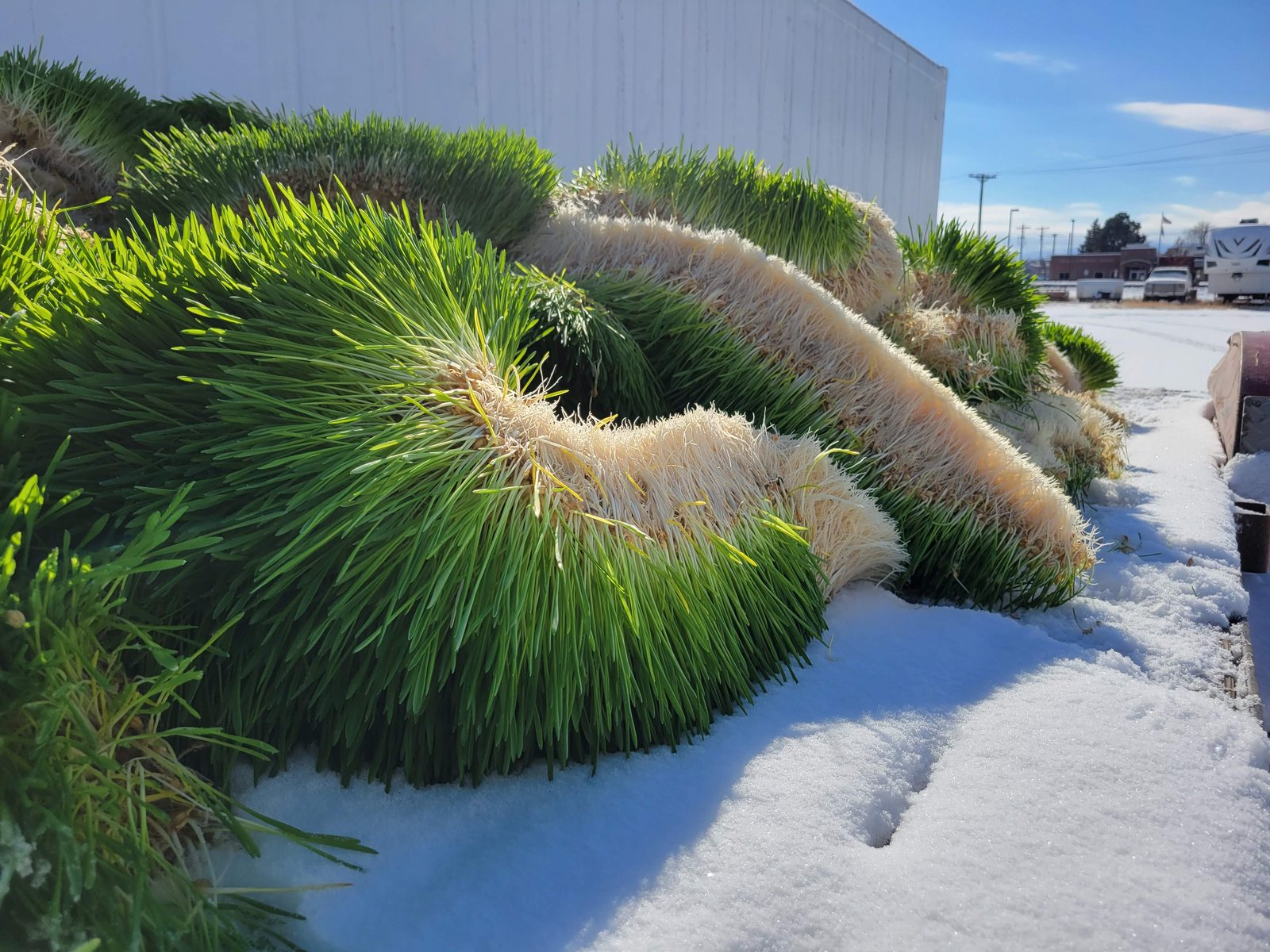
Fodder is one of the oldest words in livestock feeding. It is also one of the most loosely used. To one rancher it means the hay in the barn. To another it means trays of green barley sprouts growing in a container behind the shop.
Both are right. But the difference matters when you are deciding what to feed, what to buy and what to grow. This guide covers what fodder means, how hydroponic fodder is produced, what the research says is in it, and where it fits in a working ration.
Fodder, forage and hay: the short version
In the broadest sense, fodder is simply feed brought to livestock. The dictionary definition is “something fed to domestic animals; especially coarse food for cattle, horses, or sheep” (UVM Extension, 2016).
Forage is the wider category. The forage terminology taught through Oregon State University defines it as the “edible parts of plants, other than separated grain, that can provide feed for grazing animals, or that can be harvested for feeding.” Hay is “grass or other plants, such as clover or alfalfa, cut and dried for fodder,” and silage is forage preserved by fermentation (Oregon State University).
The practical distinction comes down to who does the harvesting. Forage can be grazed where it grows. Fodder is harvested and brought to the animal. On a working ranch, that usually means one of four things:
- Grazed forage: pasture or range the animals harvest for themselves.
- Hay: forage that is cut, dried, baled and stored.
- Silage: forage that is cut and preserved by fermentation.
- Hydroponic fodder: grain sprouted indoors without soil and fed fresh, within about a week.
When ranchers and feed suppliers talk about “fodder systems” today, they almost always mean the last of those. That is the focus of the rest of this guide.
What hydroponic fodder is
Hydroponic fodder is grain, most often barley, sprouted in trays without soil. University of Vermont Extension describes the process plainly: grain is soaked for about 8 to 12 hours, placed in trays and grown at a constant temperature, typically between 60°F and 70°F, for 6 to 8 days. The result is a mat of shoots and roots that is cut and fed fresh (UVM Extension, 2016).
The whole mat goes to the animal: seed, root and green shoot together. Nothing is dried, baled or stored. A new batch is seeded every day and a mature batch is harvested every day, so the system works as a rolling daily supply rather than a stockpile.
Barley dominates for good reason. A 2025 systematic review of 28 peer-reviewed studies on hydroponic forage in ruminant diets found that 61% of them focused on barley, which the authors said confirms its suitability for hydroponic cultivation (Vastolo and Cutrignelli, 2025).
The idea itself is not new. Fodder systems have been used on livestock farms around the world since the 1600s (UVM Extension, 2016). What has changed is the equipment: climate-controlled containers, rack systems and automated facilities that make the process consistent at commercial scale.
Sprouting grain for livestock is not a new idea. Growing it the same way, every day, at scale, is what modern systems are built to do.
What is in it
Sprouting changes the grain. As the seed germinates, enzymes break stored starch, protein and fat down into simpler forms; starches, for example, convert to sugars. That is why sprouted grain is regarded as a highly digestible feed. Several studies have also reported increases in vitamins such as A and E, though nutritionists caution that some of those increases may not be biologically significant at typical feeding rates (UVM Extension, 2016).
Protein is where well-grown fodder stands out. Barley fodder from Eleusis systems typically runs at 17 to 18% crude protein on a dry-matter basis. For context, a 2025 systematic review put the average across 21 studies, covering a wide range of growing conditions, at 14.8% (Vastolo and Cutrignelli, 2025).
The other number to remember is dry matter. Fresh fodder is mostly water: Washington State University Extension lab-tested seven-day barley fodder at 13.9 to 16.2% dry matter and worked from 15% in its own on-farm assessment (Kerr et al., 2014). That is not a flaw, but it does shape how fodder should be valued: always dry matter to dry matter, never pound for pound as fed.
Why ranchers grow it
Extension researchers who have reviewed both the scientific literature and on-farm experience point to a consistent set of reasons producers adopt fodder systems (UVM Extension, 2016):
- Fresh feed all year: sprouted grain can be fed through winter and other non-grazing months, not just in season.
- A supply that is not weather dependent: production happens indoors, so drought, hail and a short cutting season do not set the output.
- High output from a small footprint: stacked trays produce a high yield in a small space, which suits land-limited operations.
- Palatability: farmers consistently report that animals eat it readily and leave little waste.
Put simply, fodder gives selected producers a way to take control of some part of their forage supply (Kerr et al., 2014). For a ranch that has watched hay prices swing with every drought, that control is the point.
What it is not
Hydroponic fodder is a supplement, not a replacement for hay, pasture or a balanced ration. The 2025 review concluded that it can serve as a complement to conventional feed resources when properly integrated into balanced diets. For small ruminants and growing animals, moderate inclusion of 5 to 25% of dry matter improved intake, digestibility and growth, while excessive replacement reduced intake or digestibility (Vastolo and Cutrignelli, 2025).
It also asks something of the operator. The warm, humid conditions that suit sprouting barley also suit mold, so seed quality and sanitation are daily disciplines rather than afterthoughts. We cover that in The Hidden Cost of Mold. Capital cost, labor, energy and cost per pound of dry matter all belong in the evaluation too; see Why the $70K Price Tag Stops Ranchers and where the resources in a fodder system actually go.
The useful question is not whether fodder can replace hay. It is how much of the ration it can carry, and at what cost.
Where fodder fits
Fodder earns its place where an operation faces a specific constraint: an unreliable hay supply, drought-limited pasture, limited land, or a need for consistent fresh feed through the winter. University of Vermont Extension summarizes the opportunity as strongest in drought-prone regions and on farms that are land or water limited, provided cost, mold and dry-matter losses are weighed honestly against the benefits (UVM Extension, 2016).
That is the right way to approach it. Eleusis has been engineering fodder systems around those realities since 1985, across more than 400 installations in 18+ countries, from a single container to automated facilities producing hundreds of tons a day. In every one, the starting point is the same: what the herd needs, what the operation already feeds, and what share of that ration fresh fodder should carry.
Fodder is feed brought to the animal. Hydroponic fodder is fresh feed grown on-site, every day, regardless of the weather. Its value is in how well it fits the ration around it.
Go deeper on the nutrition
Our research brief, Addressing Skepticism About Fodder’s Nutritional Claims, looks at why nutritionists were cautious about fodder, the dry-matter math we do not dispute, and what the newer research shows.
And if you want to know what a fodder system would look like on your operation, contact the Eleusis team to talk through your herd, your current feed and your production goals.