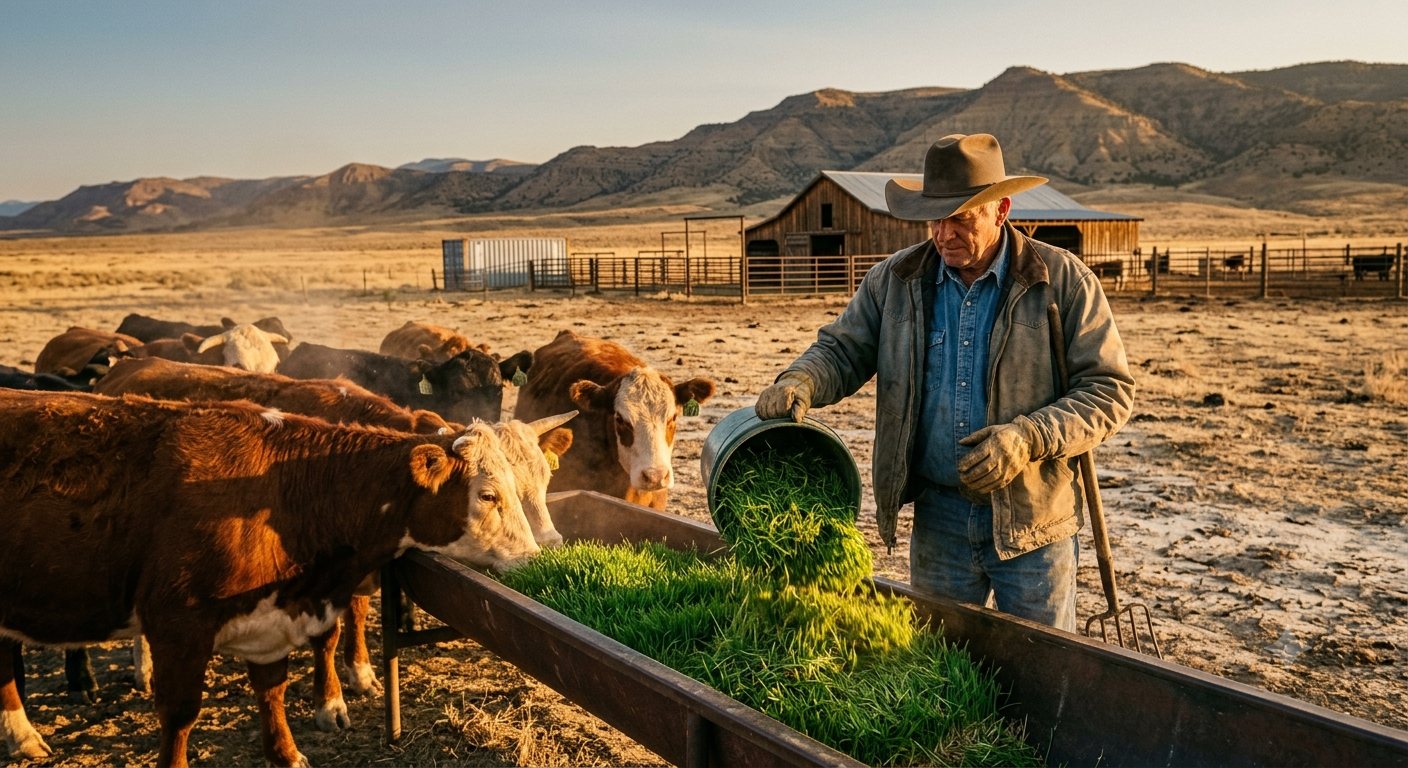
A hydroponic fodder system costs between $70,000 and $120,000 fully installed, depending on scale. For many ranchers, that number alone ends the conversation — even after they have already decided the technology could help their operation.
This is not a hypothetical objection. Industry observation suggests that prospects who complete a technical evaluation and express strong interest in adoption most commonly disengage at exactly the point where total installed cost is presented. Not because the technology fails to convince them, but because the price tag arrives at the wrong moment in an already difficult financial year.
That timing problem sits at the center of a new Eleusis research brief, The Capital Cost Barrier: Why Hydroponic Fodder Adoption Stalls at the Price Tag, and How Ranchers Can Move Past It. The full report examines why the price barrier exists, why it disproportionately affects the ranchers who need feed security the most, and what financing tools exist to close the gap. This post walks through the key findings.
The number that stops the conversation
Installed hydroponic fodder systems span a wide price range depending on scale and configuration. A small, entry-level containerized unit — typically a 40-foot module producing approximately 500 kilograms, or roughly 1,100 pounds, of fodder per day — generally costs between $70,000 and $75,000 fully installed, a figure that includes freight, commissioning, and staff training. A mid-scale system sized for 100 to 200 head of cattle typically runs closer to $120,000.
These figures are not unusual for agricultural capital equipment. Feed mixers, hay balers, irrigation pivots, and grain storage systems routinely fall within or above this range. What distinguishes the fodder system purchase decision is timing. It is frequently evaluated by operators who are simultaneously managing acute feed cost pressure, meaning the capital decision is made under financial stress rather than during a period of planning flexibility.
The ranchers who need it most are often the ones who can least afford it
There is a structural tension at the center of the hydroponic fodder value proposition. The ranchers facing the greatest feed insecurity, those in drought-affected regions of the Central and Western United States, are often operating with the thinnest financial cushion at precisely the moment adoption would be most valuable.
Farm sector data illustrate the pressure. Nearly 40 percent of agricultural lenders reported slower loan repayment rates in 2025, with tightening underwriting standards driven by concerns over collateral, liquidity, and farm-level contingency planning (Kansas City Fed). Total U.S. farm-sector debt is forecast to increase 5.2 percent to reach $624.7 billion in 2026 (USDA ERS). At the same time, drought conditions have forced difficult financial decisions across cattle country. Ranchers facing water shortages have reported selling breeding cattle representing years or generations of herd development, and in some cases paying more in freight than in feed cost to bring hay in from hundreds or even thousands of miles away.
This is precisely the population most likely to recognize the value of on-site, water-efficient fodder production — and least likely to have $70,000 to $120,000 in available capital or borrowing capacity sitting idle. Ignoring that tension does not make it disappear. Addressing it honestly, rather than treating it as a simple sales objection, is the only way forward.
The upfront price is not the number that matters
Evaluating a hydroponic fodder system purely on installed cost obscures the more relevant comparison: cost per pound of feed produced over the operating life of the system, set against the trajectory of hay prices in an operator's region.
Reported barley sprout production costs for hydroponic systems generally fall between $0.05 and $0.06 per pound. By comparison, prices in drought-affected areas of Colorado have recently ranged from $300 to $400 per ton of hay (Western Slope Now), equivalent to roughly $0.15 to $0.20 per pound, before accounting for the freight costs that ranchers increasingly absorb when local hay supply tightens. Water use tells a similar story. Producing one pound of hydroponic fodder requires less than one quarter of a gallon of water, compared with more than 40 gallons for an equivalent pound of hay — a differential that becomes financially material as water allocations shrink and irrigation costs rise.
These figures should be treated as illustrative rather than universal. Actual payback periods depend on herd size, existing feed costs, regional hay price volatility, labor allocation, and the specific ration inclusion rate a nutritionist recommends — typically 30 to 50 percent of an animal's diet rather than a full hay replacement.
Financing options that change the math
Several mechanisms exist that can meaningfully lower the effective cost of adopting hydroponic fodder technology, though eligibility and availability vary by state, operation type, and applicant status.
- USDA Environmental Quality Incentives Program (EQIP). EQIP, administered by the USDA Natural Resources Conservation Service, provides cost-share financial assistance to agricultural producers implementing approved conservation practices, including practices tied to drought resilience and water use efficiency. Standard EQIP cost-share generally covers up to 75 percent of eligible practice implementation cost, with historically underserved producers, including beginning farmers and ranchers, eligible for cost-share rates of up to 90 percent. Because EQIP is a reimbursement program by default, out-of-pocket cost can still be a barrier. However, the EQIP Advance Payment Option allows eligible historically underserved producers to receive at least 50 percent of contracted payment before implementation, specifically to help offset upfront material and installation costs.
- USDA Farm Service Agency (FSA) loans. FSA direct operating and farm ownership loans offer government-backed financing, in 2025 carrying interest rates in the range of 5.00 to 5.75 percent, with long fixed terms available for beginning, minority, and socially disadvantaged farmers.
- Farm Credit System and private agricultural lenders. Agricultural lenders continue to finance equipment purchases of this kind, though underwriting has tightened industry-wide. Structuring debt payments to align with an operation's income cycle, and using revolving credit lines for a portion of the capital outlay rather than a single lump-sum loan, are strategies some lenders will help structure.
- Blended approaches. In practice, the most viable path for many operators combines a partial EQIP cost-share award with either an FSA loan or private agricultural credit line to cover the remaining balance, reducing net out-of-pocket exposure well below the full $70,000 to $120,000 installed price.
The real risk is not the price tag
It is reasonable for a rancher evaluating a $70,000 to $120,000 decision to pause. But the relevant question is not whether that number feels large in isolation. It is what happens if the operation continues to depend entirely on a hay market that is becoming less predictable and more expensive every season.
The operators facing the greatest feed insecurity are often those with the least cash on hand. But limited liquidity is not the same as limited options.
The full research brief, The Capital Cost Barrier, walks through the complete total cost of ownership framework and the financing pathway details referenced above.
Eleusis works directly with ranchers, equestrian facility managers, and dairy producers to walk through installed cost, projected total cost of ownership, and available USDA EQIP and financing pathways for a specific operation. If the price tag is the wall standing between your operation and feed security, contact the Eleusis team to talk through the numbers for your ranch and find a path that fits your operation's cash flow.