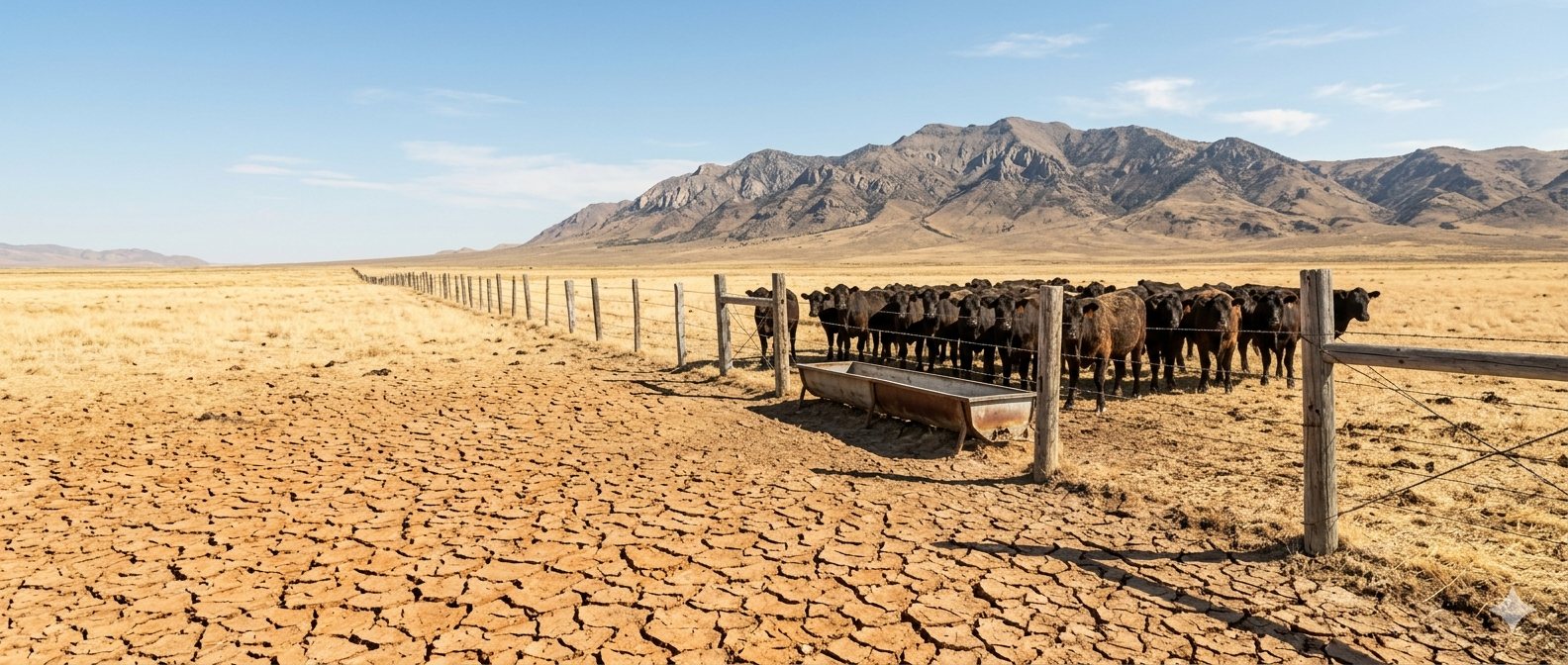
Across the American West, a quiet crisis is forcing ranchers to make decisions they hoped they would never face. The animals are healthy. The market is strong. But the hay is not there — or it is there at a price that makes keeping the herd whole economically impossible.
Feed supply security has broken down. Not in one place, not in one season, but across a wide swath of the West in a pattern that federal agricultural data, climate records, and industry economists now describe as structural rather than cyclical. In our research brief, Hay Price Volatility and Forage Supply Insecurity in the American West, we draw together the data behind this shift, examine the forces driving it, and make the case for a different approach to how livestock operations source their feed.
The findings are stark. Hay prices in drought-affected regions of Colorado reached $300 to $400 per ton during severe drought periods, against a historical norm of $150 to $180 per ton (Western Slope Now). The United States cattle herd has contracted to 86.7 million head, the smallest inventory recorded in 74 years. And snowpack in the Colorado River Basin, the primary source of irrigation water for western hay producers, hit its lowest recorded levels in the winter of 2025 to 2026 (U.S. Bureau of Reclamation).
The ranchers caught in this environment are not making decisions from a position of weakness or mismanagement. They are managing well in a system that has become structurally unreliable.
The hay market has changed, permanently
Hay prices follow the same logic as any commodity: when supply falls and demand rises, prices spike. What has changed in the American West is that drought now triggers both sides of that equation simultaneously, and with increasing frequency.
When drought reduces pasture forage, ranchers who would normally graze their animals through summer and autumn must instead purchase hay. At the same moment, the drought that pushed them into the hay market has also reduced local hay production, sometimes by 20 to 30 percent in the most severely affected counties. The result is a regional supply squeeze that national production averages obscure entirely.
Analysts at Terrain Agriculture Analytics noted that hay prices declined on a year-over-year basis for 25 consecutive months through mid-2025, reflecting a genuine national production recovery (Terrain Ag). But that national figure does not reach a rancher in La Plata County, Colorado, whose local hay is priced out of reach and whose freight costs to source hay from a surplus state have climbed 18 to 22 percent quarter-over-quarter.
People are having pain points this year that they hadn't necessarily had before. The affordability of hay and the logistics of transporting dry feed from far locations are becoming a burden.
Eric Gostenik — VP of Sales / Chief Strategy Officer, Eleusis
Snowpack is the upstream cause
To understand why hay supply in the American West has become so volatile, it is necessary to look upstream, literally. Approximately 85 to 95 percent of the water supply in the Colorado River Basin originates from the upper basin snowpack (SnowBrains). That snowpack feeds the rivers, which feed the irrigation canals, which water the hay fields that ranchers depend upon.
That snowpack is in long-term decline. As of early 2025, snowpack in the Lower Colorado River Basin reached levels as low as 23 percent of the historical median. Multiple monitoring stations across the San Juan and Sangre de Cristo ranges recorded their lowest or second-lowest peak snowpack values since installation in the late 1970s and early 1980s (Colorado Climate Center). The winter of 2025 to 2026 continued the pattern: satellite data confirmed snow-covered area in the Upper Colorado River Basin at approximately 40 percent of typical early-March coverage, the lowest figure recorded since satellite measurements began in 2001.
Less snowpack means less irrigation water. Less irrigation water means less hay, at lower quality, harvested from fewer acres. Some fields are left fallow entirely when irrigation water becomes unavailable or prohibitively expensive to secure. Those uncut fields translate directly into higher prices and tighter supply for the ranchers who do not produce their own hay.
The Colorado River Compact, established in 1922 and up for post-2026 renegotiation, was structured around water allocations that the river no longer consistently delivers even under historical conditions. The combination of structural overallocation and climate-accelerated snowpack decline has produced a chronic, worsening mismatch that no single good winter will resolve.
Freight costs are compounding the damage
A rancher who cannot source hay locally has one option: source it from elsewhere and pay to move it. In the American West, where the distances between surplus production areas and drought-affected ranches can span entire states, that freight cost has become a significant and growing burden.
United States trucking costs for grain routes to Pacific Northwest and Gulf port destinations increased 18 to 22 percent quarter-over-quarter in the first quarter of 2025, driven by wage increases, chassis shortages, and terminal congestion (Grain Journal). These structural pressures apply equally to hay freight. The American Farm Bureau Federation has documented cases where ranchers paid more on freight than on the hay itself, having sourced feed from hundreds or even thousands of miles away (AFBF).
For smaller operations without the purchasing volume to negotiate favorable freight terms, this cost structure is often prohibitive. For larger ones, it introduces operational risk beyond the financial dimension: delivery timing becomes less predictable, quality control more difficult, and nutritional consistency harder to guarantee when hay is sourced from multiple distant suppliers across multiple cuttings.
The herd tells the story
The cumulative effect of these pressures is visible in the herd numbers. The United States cattle herd has contracted from 94.7 million head in 2019 to 86.7 million head as of January 2025, an 8 percent reduction representing the smallest inventory since 1951 (Durango Herald). Six consecutive years of herd contraction, driven by drought, high input costs, and feed supply insecurity, have eliminated decades of genetic development, breeding progress, and productive agricultural capital.
Oklahoma State University livestock marketing specialist Derrell Peel has estimated that even if producers began rebuilding herds immediately, a measurable recovery in herd size would not be visible until 2029 (Oklahoma Farm Report). The biological realities of cattle reproduction mean that herd capital, once liquidated, takes years to restore. Record beef prices in 2025 benefited operators with animals to sell; they did not compensate those who had already exited production.
Drought has affected an estimated 50 percent of all United States cattle, according to data from the National Drought Mitigation Center (NDMC). The cascading consequences extend beyond individual operations to packing plant utilization, rural community economies, and long-term beef supply chains.
Feed security is infrastructure, not a purchasing decision
Our whitepaper's central argument is straightforward: the conditions driving hay price volatility are structural, not episodic, and they require a structural response. Treating feed supply as a purchasing decision — buying hay when needed at whatever the market charges — is no longer a viable risk management strategy for operations in drought-exposed regions.
On-site feed production capability offers a fundamentally different posture. By growing feed on-site in soil-free, climate-controlled environments, producers can insulate a meaningful portion of their daily ration from hay market volatility, freight costs, and weather variability entirely.
Hydroponic green fodder systems grow fresh barley sprouts in 7-day cycles using less than 0.25 gallons of water per pound of fodder produced, at a production cost of $0.05 to $0.06 per pound. The feed is delivered to animals daily and incorporated into existing rations at 30 to 50 percent of total feed volume, depending on species and production goals. The system does not eliminate the need for purchased forage, but it anchors the ration with a cost-controlled, weather-independent ingredient that hay markets cannot match for consistency.
Feed consistency is a central part of the value proposition. With hay, every cutting, supplier, field, and delivery can vary. When you can produce a fresh feed ingredient the same way, every day of the year, nutritionists and operators gain a level of predictability they really appreciate.
Joaquin Gonzalez — Chief Expansion Officer, Eleusis
For ranchers managing high-value animals, or those who have watched drought force herd culling decisions on neighbouring operations, the economics are not primarily about the cost per pound of fodder. They are about the cost of not having a reliable feed supply when the hay market fails.
The cost of waiting
Ranchers who have spent generations building their herds have already absorbed extraordinary losses in this contraction cycle. The question facing operations across the West now is whether feed supply risk will be managed proactively, through investment in on-site production capability, or reactively, through market purchases at prices that drought-driven supply squeezes will periodically make unsustainable.
The data presented in the whitepaper makes the structural nature of the problem clear. Snowpack is not recovering. The Colorado River Compact is under renegotiation amid a chronic water deficit. Freight costs reflect structural pressures that are not seasonal. The ranchers who navigate this environment most successfully will be those who treat feed security as infrastructure rather than as a line item on next month's invoice.