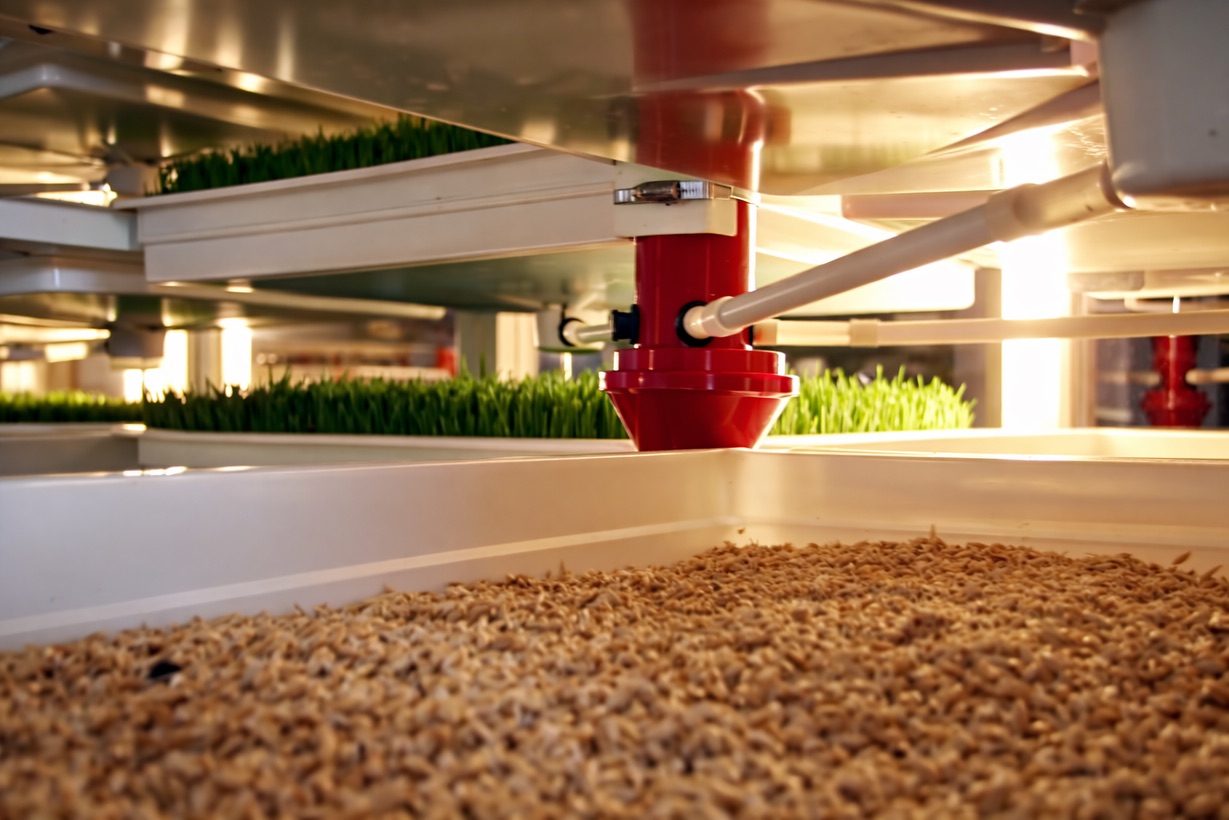
Hydroponic fodder can reduce water requirements and produce fresh feed in a compact, controlled environment. But those benefits do not mean the resources required to produce feed disappear. They mean those resources are used differently.
For livestock producers facing drought, rising feed costs and unreliable forage supplies, that distinction matters. The question is not simply how much green fodder a system produces. It is how efficiently the system converts water, grain, energy and capital into useful nutrition.
The real measure of resource efficiency is not what a system produces. It is what those resources deliver in return.
More green weight does not necessarily mean more feed
One of the most visible features of hydroponic fodder is the transformation of grain into a dense mat of roots, shoots and leaves in approximately seven to ten days. The resulting crop can weigh several times more than the original seed.
But much of that increase comes from absorbed water.
Dry matter—the portion of feed remaining after moisture is removed—is a more meaningful starting point for comparing the nutritional contribution of hydroponic fodder with conventional feed. During germination, the grain uses stored carbohydrates to support growth, and some of that dry matter is lost through respiration.
A critical assessment of hydroponic fodder production published through Feedipedia reported dry-matter losses ranging from approximately 7% to 47% in studies of grain sprouted for six to seven days. Results varied with the grain and growing conditions (Feedipedia, 2017).
The implication is straightforward: fresh-weight yield alone can give an incomplete picture of production efficiency.
For producers, the more useful measures are dry-matter recovery, nutrient composition, feed intake and the amount of conventional feed the fodder actually replaces.
Water efficiency depends on what you measure
Water is one of the most frequently discussed advantages of hydroponic fodder, particularly in regions where drought and irrigation constraints affect forage production.
Conventional forage crops depend on rainfall or irrigation across a growing season. Hydroponic systems deliver water directly to a crop in a controlled environment, allowing producers to manage irrigation and, in some systems, recirculate water.
Research into hydroponic green forage has demonstrated the potential to reduce water requirements compared with certain conventional production methods (Al-Karaki and Al-Hashimi, 2012). A 2024 study examining atmospheric water generation for hydroponic forage, for example, evaluated a water requirement of approximately 1.5 to 3.0 liters per kilogram of forage under its study conditions (Casallas et al., 2024).
But the comparison requires care.
Fresh hydroponic fodder contains substantial moisture, so water-use figures expressed per kilogram of fresh biomass are not directly equivalent to figures expressed per kilogram of dry matter. Results also depend on the crop, climate, irrigation method and conventional feed being replaced.
For a rancher, the important question is not simply how much water enters the growing system. It is how much water is required to deliver a useful amount of nutrition compared with the alternative.
Seed and energy remain part of the equation
Hydroponic fodder production begins with grain. That grain has already required land, water, energy and labor to produce. Germination changes the form of the feed, but it does not erase the resources invested in the seed.
Energy introduces another consideration.
Pumps, ventilation, lighting where required, climate management, sanitation and equipment maintenance all contribute to operating costs. Their significance varies with system design, environmental conditions and operating practices.
Research published in the Journal of Cleaner Production in 2022 examined energy use and environmental sustainability in hydroponic green forage production, highlighting the importance of evaluating production inputs alongside potential resource savings (Ghasemi-Mobtaker et al., 2022).
These trade-offs do not make hydroponic fodder inherently inefficient. They make system design and operating performance important.
A resource advantage in one area should be evaluated alongside the resources required elsewhere.
Efficiency is not about making inputs disappear. It is about getting more useful value from the resources an operation commits.
Where hydroponic fodder fits
Hydroponic fodder is best evaluated as a potential component of a broader feeding strategy, not an automatic replacement for hay, pasture or a balanced ration.
A 2025 systematic review by Vastolo and Cutrignelli examined 28 peer-reviewed studies of hydroponic forage in ruminant nutrition. The researchers identified potential benefits in some feeding outcomes, while also noting limitations related to dry-matter concentration, nutritional composition and production conditions (Vastolo and Cutrignelli, 2025).
The practical implications depend on the operation.
A ranch dealing with unreliable forage availability may value another source of fresh feed. An operation purchasing expensive hay may investigate whether hydroponic fodder can economically displace a portion of that supply. A producer with relatively inexpensive conventional feed and high electricity costs may find that the numbers are less favorable.
The relevant question is whether the system improves the overall feeding equation. That requires looking at:
- Dry matter: How much usable feed is produced?
- Water and energy: What resources are required to produce it?
- Feed displacement: How much conventional feed does it actually replace?
- Animal nutrition: Does the ration maintain appropriate intake and performance?
- Total cost: Do seed, labor, utilities, maintenance and equipment justify the result?
The economics will differ between operations. That is why resource efficiency should be evaluated against the producer’s actual feeding needs rather than a single headline yield.
The value is in the whole system
The environmental and operational value of hydroponic fodder cannot be established by measuring water use or fresh-weight production alone.
A meaningful comparison considers the resources required to produce the seed, operate the growing system, harvest the crop and deliver nutrition to livestock. It also accounts for the feed that is genuinely displaced.
If hydroponic fodder supplements an existing ration without reducing other feed requirements, the expected resource savings may be limited. If it replaces a portion of an expensive or resource-intensive feed source while maintaining appropriate nutrition, its value may be more substantial.
Location matters, too. A system that helps an operation manage limited water supplies or unreliable forage markets may provide resilience benefits that are difficult to capture in a single production metric.
No single technology eliminates the risks associated with livestock production. The opportunity is to give producers another option and understand when that option makes sense.
From resource efficiency to feed security
For livestock producers, resource efficiency is ultimately connected to feed security.
Water availability, forage production, transportation, input prices and weather all influence the cost and reliability of feeding a herd. Diversifying feed production can offer another way to manage some of those pressures, provided the system’s costs and nutritional contribution fit the operation.
Hydroponic fodder is not a universal solution, and it should not be judged by fresh-weight yield alone. Its value depends on how well it performs within the broader feeding strategy.
Hydroponic fodder doesn’t eliminate waste. It changes where the resources go. The opportunity is to make sure those resources go further.
Get the full picture
Our whitepaper, Why Ranchers Who Adopted New Feed Technology Made the Leap, explores the economic pressures and practical considerations that influence technology adoption in livestock operations.
The research examines why producers evaluate new feed technologies in the context of their existing costs, operational constraints and expected returns. Those same considerations are essential when assessing whether hydroponic fodder can contribute to a more resilient feeding strategy.