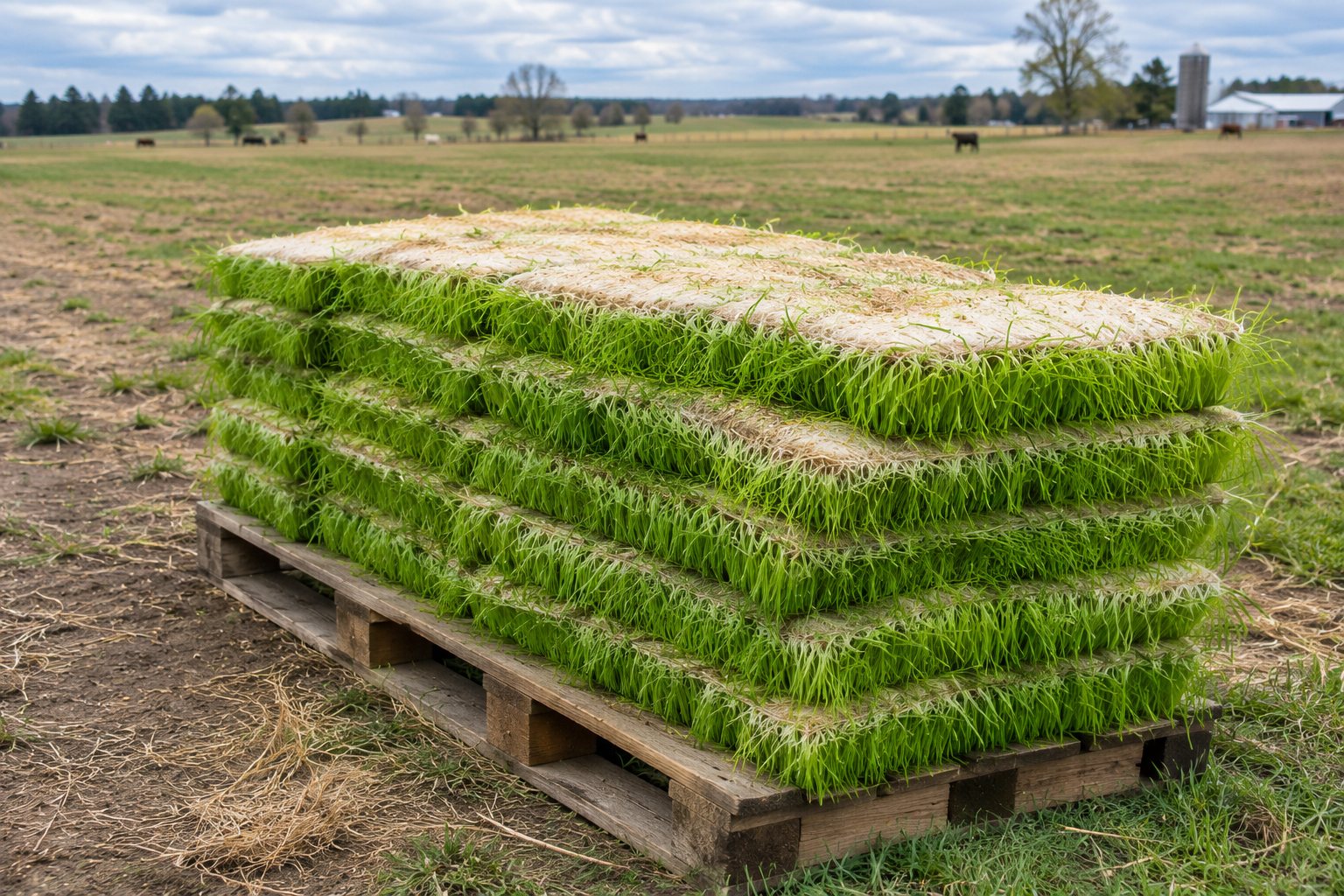
A rancher investing in a grass-fed herd has more to protect than the livestock. There is the certification, the relationship with buyers and the price premium associated with how those animals are raised.
Now consider hydroponic fodder. It begins with cereal grain, usually barley or wheat, and develops into fresh green forage. It can offer another feed option when pasture growth slows or winter conditions limit grazing. (For the basics, see What Is Fodder? A Plain-English Guide.)
But does feeding that green forage change the herd’s grass-fed status?
The answer depends on which standard applies. Some certification programs recognize sprouted fodder under defined conditions. Others prohibit it during normal feeding.
Hydroponic fodder can fit a grass-fed production program, but certification depends on the feed, the season, the amount offered and the specific rules governing the herd.
Grass-fed is a feeding standard, not simply a description of green feed
A grass-fed claim does not depend on whether the ration looks green. It depends on what the animals consume throughout the qualifying production period and whether the operation satisfies the applicable labeling or certification rules.
The USDA Food Safety and Inspection Service (FSIS) defines forage as grass, forbs such as legumes, browse and cereal grain crops in the vegetative (pre-grain) state. Hay, haylage and other roughage sources can also form part of a grass-fed ration (USDA FSIS, 2024).
However, FSIS distinguishes forage from grain and grain by-products, which grass-fed animals cannot be fed. Its guidance also requires continuous access to pasture during the growing season for an unqualified grass-fed claim. Growing livestock feed indoors does not satisfy that pasture requirement by itself (USDA FSIS, 2024).
That distinction matters because a hydroponic barley mat contains emerging grass, roots and the remains of the germinated seeds. Its classification under a particular standard cannot be assumed simply from the presence of green shoots.
The American Grassfed Association explicitly permits sprouted fodder
For producers considering a hydroponic system, this is where the rules become specific.
The American Grassfed Association (AGA) addresses sprouted fodder directly in Section 3.3.8 and Appendix A of its 2024 Grassfed Ruminant Standards. Under those rules, approved use of sprouted fodder can be compatible with AGA certification (American Grassfed Association, 2024).
The conditions are specific:
- Season: Sprouted fodder is permitted as an optional source of live grass only during the non-grazing season.
- Seed quality: Seed must achieve a 98% germination rate.
- Feeding limit: Daily fodder weight must not exceed 1.75% of the animal’s body weight or 20 pounds per head, whichever is less.
- Feed safety: Mold and mycotoxins should not be present in the fodder being fed.
These are requirements of a specific certification program, not universal allowances for grass-fed cattle. AGA also requires records of supplemental feedstuffs, including the amounts offered and when they were fed (American Grassfed Association, 2024).
The significance is practical. A producer following AGA standards may have a route to using hydroponic fodder without sacrificing certification. That route requires compliance with the conditions, not merely purchasing the equipment.
Grass-fed certification does not necessarily exclude indoor-grown forage. It requires that the forage be used within the rules of the certification program.
Other certification programs take a different position
The distinction becomes clear when comparing AGA with A Greener World (AGW), another organization offering grass-fed certification.
AGW’s Certified Grassfed standards expressly prohibit sprouted grains during routine feeding. They list sprouted grains among prohibited feedstuffs alongside grains and grain by-products, even though fodder has developed green shoots and roots (A Greener World, 2024).
AGW does allow producers to request an exception, which it calls a derogation, during drought or another emergency. That exception requires prior approval and limits sprouted grain fodder to 25% of the animal’s daily dry matter intake (A Greener World, 2024).
The contrast is substantial. AGA permits controlled seasonal use under its standards. AGW generally prohibits the same feed, except through an approved emergency exception. Neither program should be treated as representative of every grass-fed certification in North America.
U.S. grass-fed labeling and private certification are different
In January 2016, the USDA Agricultural Marketing Service withdrew its voluntary national Grass (Forage) Fed Marketing Claim Standard. That decision did not end the ability of producers to seek approval for grass-fed meat labeling (USDA AMS, 2016).
USDA FSIS continues to oversee grass-fed claims on meat products. Its August 2024 guideline explains that unqualified grass-fed claims require a forage-only diet after weaning, with continuous pasture access during the growing season. The agency also reviews documentation supporting the claim (USDA FSIS, 2024).
AGA certification provides a defined standard under which seasonal sprouted fodder is expressly recognized. But that does not mean every hydroponic barley feeding program automatically qualifies for an FSIS-approved grass-fed label. The relevant production protocol and label documentation still matter.
For U.S. producers, the practical approach is to distinguish the farm’s certification requirements from the meat processor’s labeling approval requirements. Both should be checked before an established feeding program changes.
What about grass-fed cattle in Canada?
Canadian producers face a somewhat different labeling framework.
The Canadian Food Inspection Agency (CFIA) requires method-of-production claims on food labels and in advertising to be truthful, supportable and not misleading. Supporting evidence may include production records, third-party audits or non-government certification programs (CFIA).
CFIA’s published guidance does not provide a specific blanket ruling that hydroponic barley fodder qualifies for every grass-fed claim. As a result, Canadian producers should not assume that compliance with an American certification standard establishes compliance for their own products.
A Canadian ranch selling beef under a private grass-fed program should obtain written clarification from that program before introducing sprouted fodder. Processors, retailers and branded beef programs may also impose contractual feeding requirements.
For Canadian beef entering the U.S. market, American labeling requirements add another consideration. A feeding practice acceptable to a Canadian buyer does not automatically establish eligibility for a particular U.S. meat label.
A feed can be suitable for cattle without being suitable for every certified feeding program. Those are different decisions.
Certification eligibility does not establish nutritional value
Even where fodder is permitted, the feeding decision still requires nutritional evaluation.
Hydroponic barley fodder contains substantial moisture. In a 2023 controlled study, Soufan measured 12.99% dry matter in fresh fodder produced entirely from barley seed (Soufan, 2023). Actual values depend on the seed, growing conditions and harvested material.
At that study’s dry matter concentration, a 20-pound fresh ration would deliver approximately 2.6 pounds of dry matter. This is an illustration, not a fixed nutritional value for all hydroponic fodder. The distinction matters when balancing a ration against hay or other stored forage.
Producers should evaluate crude protein, fiber, energy and dry matter alongside feed cost. Hydroponic fodder may provide useful fresh forage during seasonal shortages, but it does not eliminate the need for effective fiber, hay, pasture or a properly balanced ration.
Feed hygiene also matters. AGA’s condition that mold and mycotoxins should not be present makes seed inspection, sanitation, environmental control and regular monitoring essential to compliance (American Grassfed Association, 2024). (We cover the risks in The Hidden Cost of Mold in Hydroponic Fodder Systems.)
Producers should confirm eligibility before changing the ration
For an operation already receiving a grass-fed premium, the safest approach is to resolve certification questions before installing a system or introducing sprouted barley.
Begin with the written standard governing the herd. Determine whether it permits sprouted fodder, whether permission is seasonal and whether a maximum daily allowance applies.
A practical compliance record should include:
- Written approval: Confirm that the certifier accepts the proposed fodder and feeding schedule.
- Seed documentation: Retain supplier details, seed lot identification and germination test results.
- Feeding records: Record daily fresh weight offered, animal groups and dates.
- Quality control: Maintain inspection, cleaning and rejected-batch records to document feed safety.
- Nutritional review: Have the total ration evaluated on a dry matter basis.
Records protect both the certification claim and the feeding decision. They allow a producer to demonstrate what was fed, why it was fed and whether the practice remained within the approved standard.
The business case should then be evaluated independently. The value of seasonal fresh forage depends on feed availability, seed cost, energy, labor and the operation’s ability to use the harvested material consistently.
Hydroponic fodder is best considered a supplementary feed option rather than an automatic substitute for conventional forage. For grass-fed producers, protecting certification status is part of calculating its real economic value.
Grass-fed eligibility is not determined by how green the fodder looks. It is determined by the feeding standard the operation must meet.
Get the full picture
Seed quality becomes especially important when a certification standard sets a defined germination requirement.
Eleusis has published Seed Sourcing & Quality Consistency, a research brief covering germination testing, seed procurement and the effect of seed quality on dependable daily fodder production.
Producers evaluating hydroponic fodder for a grass-fed operation can also contact Eleusis to discuss system requirements, seed quality and feed planning alongside the requirements of their certification program.